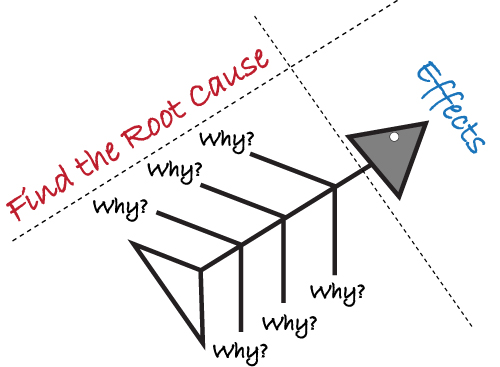

5 Whys and Fishbone Diagram are effective tools that can be used to locate the roots causes of a problem.
5 Whys is a problem solving tool that helps to get to the root of a problem. The basic idea is to ask “Why?” whenever a problem is encountered. Typically, the initial response will not trace back to the root of the problem it will only be a symptomatic representation of the overall issue.
Fishbone Diagram goes by several names (Ishikawa, Cause & Effect, etc.) and there are a variety of ways to use. It is primarily a tool for organizing information to establish and clarify the relationships between an effect and its main causes. Fishbone Diagram is able to identify the root cause(s) of the problem so that collective actions can be taken to eliminate their recurrence, develop a picture composed of words and lines designed to show the relationship between the effect and its causes.
What is the target?
To understand the use of 5 Whys and Fishbone Diagram in Analyze Phase of a Six Sigma Project
Who should attend?
First and second level team leaders and managers
Quality and process improvement professionals
Those who are interested to become Lean Six Sigma professionals
Teaching Methodology
Interactive workshop and lecture
Certification
Certificate of Successful Completion will be awarded to students who have achieved attendance criteria.
Fee
Registered Professionals: HK$750
Six Sigma Community Buddies /Members of SSI Partners: HK$800
Others: HK$850
Language:Cantonese (supplemented with English)
Venue: Unit 1627, 16/F, Star House, No. 3 Salisbury Road, Tsim Sha Tsui, Kowloon
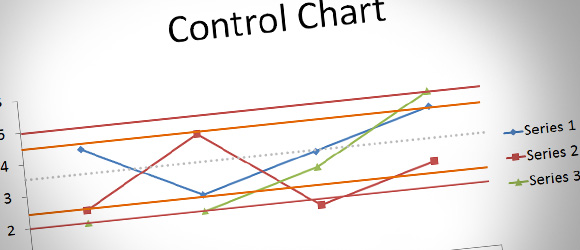
Control Charts are used in a number of places help control in a process. Control charts are used in a number of places in the Lean Sigma roadmap to test whether a process is stable and in control. By making use of control charts, Statistical Process Control (SPC) can then be applied to help control a process.
Control Charts are time charts designed to display signals or warnings of special cause variation. Special cause variation, as distinct from common cause variation, refers to changes in process performance due to sporadic or rare events indicating that a process is not ‘in control.’ The advantage of Control Charts is that they enhance the understanding of process variation making it easier to take action to reduce special cause variation and improve ongoing process performance.
What is the target?
To know about common types of control charts
To know how to use the control charts effectively
Who should attend?
First and second level team leaders and managers
Quality and process improvement professionals
Those who are interested to become Lean Six Sigma professionals
Teaching Methodology
Interactive workshop and lecture
Certification
Certificate of Successful Completion will be awarded to students who have achieved attendance criteria.
Fee
Registered Professionals: HK$750
Six Sigma Community Buddies /Members of SSI Partners: HK$800
Others: HK$850
Language:Cantonese (supplemented with English)
Venue: Unit 1627, 16/F, Star House, No. 3 Salisbury Road, Tsim Sha Tsui, Kowloon *map*
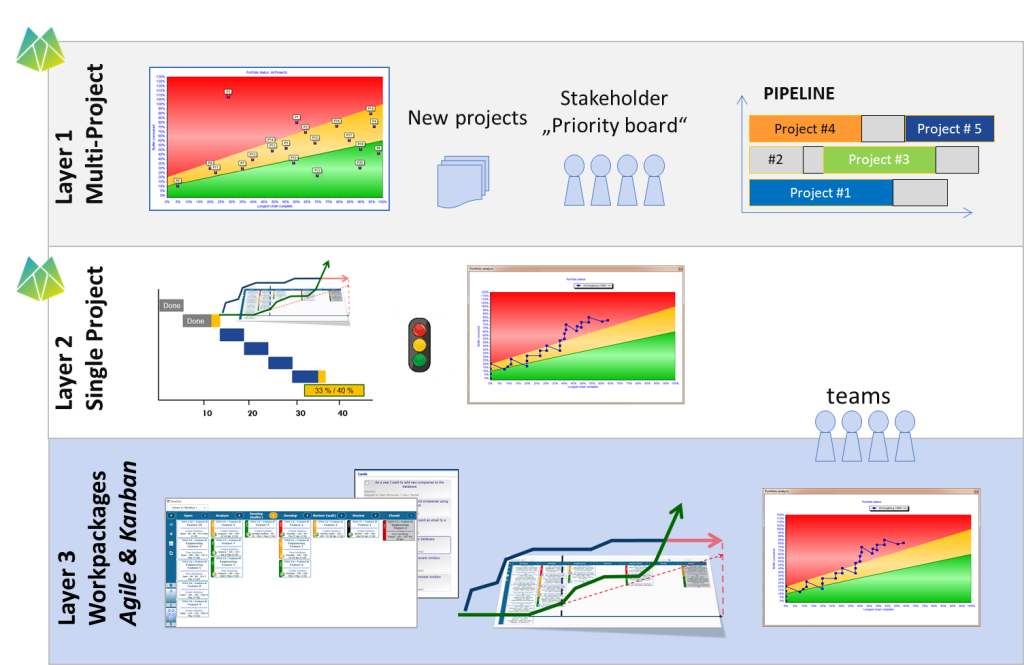
The Critical Chain Project Management (CCPM) is an innovative approach with techniques that can dramatically improve the performance of all types of projects in companies of all sizes.
This innovative approach (The Boeing Company, Mazda, OMRON, Ricoh Company etc.) has been adopted by thousands of leading organizations, and the Japanese government decided in 2008 to use CCPM in all government construction projects (about 20,000 projects per year). They all had miraculous results.
Objective:
This course will share theories and techniques to manage single projects big or small in various industries.
Facilitated by a certified CCPM expert, the workshop covers the concept, methodology, and case examples. The new techniques will be illustrated by computer simulation. The workshop covers CCPM scheduling, tracking, and project management by the CCPM software.
This is a new approach in digitalization of business. Staff needs up-dated digital training and knowledge in order to create new services and products for customers. Workshop participant will gain a basic understanding of ABCDE – Ai, Big-data, Cloud, Deep learning, Expert system, and IoT (Internet of Things). Also, this workshop will introduce a new concept in HR – the People (HR) Analytics. Also, Digital transformation is a mindset shift for HR, as it is about the increased use of technology. HR professional needs new skills and understanding of what will make staff productive in the future.